

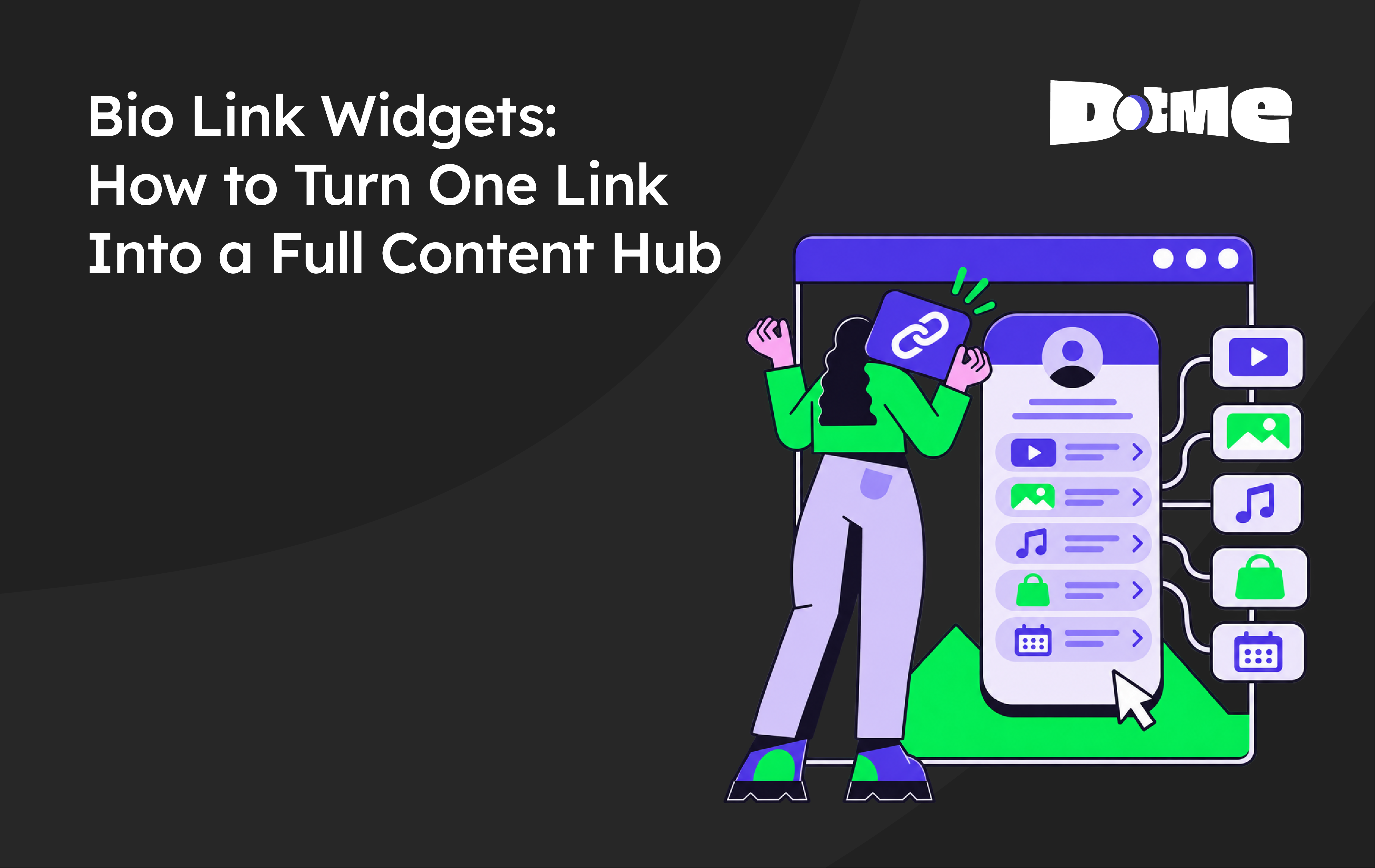
Instagram gives you one link. One. In a world where you are creating content across multiple platforms, selling products, running a newsletter, dropping new YouTube videos, and trying to funnel your audience toward whatever matters most this week, the idea that a single static URL is supposed to do all of that work is genuinely absurd.
Which is exactly why the link in bio has evolved from a simple URL into one of the most strategically important pieces of digital real estate a creator or brand owns. And why the tools built to maximise that single link, from basic link lists to full content hubs with widgets, analytics, and storefront capability, have become a category that creators are thinking about with genuine seriousness.
This guide breaks down what bio link widgets actually are, why they matter more than most creators realise, and how to use a link in bio app like Dotme to turn that one Instagram bio link into a content hub that actually works as hard as your content does.
Key Takeaways
- One link does not have to mean one destination: The right link in bio app turns a single URL into a complete, dynamic hub that houses everything your audience needs to find.
- Bio link widgets are the upgrade that separates a list of links from an actual content experience: Embedded video, Instagram feeds, Spotify players, and shoppable product carousels all live inside a well-built link in bio page.
- Dotme is a genuinely compelling Linktree alternative for creators who want more than a button list: The difference in what it can do compared to basic link aggregators is significant and commercially meaningful.
- The best link in bio tools for Instagram serve three audiences simultaneously: Your followers who want to go deeper, the brands evaluating you for partnerships, and the first-time profile visitors who are deciding in seconds whether to follow or leave.
- Analytics built into your link in bio app are not optional in 2026: Knowing which links are generating clicks and which are dead weight is the data that makes every future content decision smarter.
- Your link in bio page is your owned digital real estate: Unlike your Instagram profile, which exists at the platform's pleasure, your Dotme page is a hub you control across every platform change and algorithm shift.
What Bio Link Widgets Actually Are
A bio link widget is an interactive, embedded content element within a link in bio page that goes beyond a simple button or URL. Where a basic link in bio tool shows you a list of labelled buttons that route visitors to different destinations, a widget is a live, functional content piece that brings the destination experience into the page itself.
The most common and most impactful bio link widgets include embedded Instagram feed displays that show your most recent posts directly on your link in bio page, Spotify player embeds that let visitors listen to your playlists or latest episode without leaving the page, YouTube video players that bring your content directly into the hub, shoppable product carousels that display and link to products in a visual, browsable format, and email capture forms that convert page visitors into newsletter subscribers without routing them to a separate landing page.
What widgets change about the link in bio experience is the difference between sending your audience somewhere and bringing something to them. A visitor who encounters a shoppable product carousel on your Dotme page can browse, discover, and decide to purchase without navigating through multiple pages and losing momentum. A visitor who finds your latest YouTube video embedded directly in your bio link can watch, engage, and deepen their connection with your content in a single session. The friction reduction this produces is commercially significant in a digital environment where attention drops at every additional tap required.
Why the Basic Linktree Model Is Not Enough Anymore
Linktree was genuinely useful when it launched. It solved a real and immediate problem: Instagram's single link limitation was creating a real obstacle for creators who wanted to point their audiences to multiple destinations. A simple, clean list of buttons that aggregated those destinations into one URL was a meaningful improvement over the status quo.
But the creator economy in 2026 operates at a different level of sophistication than the one Linktree was designed for. Creators are not just directing traffic to external destinations. They are building brands, selling products, negotiating sponsorships, growing newsletters, and managing multiple content platforms simultaneously. The link in bio page has become the central infrastructure of a creator's digital presence, and a basic list of buttons is not infrastructure. It is a directory.
The Linktree alternatives that have emerged to address this gap, Dotme chief among them, are built around a fundamentally different conception of what a link in bio page should do. Not a directory of destinations but a content hub that brings the experience to the visitor. Not a list of buttons but a designed, branded, interactive page that reflects the creator's identity, showcases their content, converts visitors into customers and subscribers, and provides the analytics data that makes the whole thing continuously improvable.
For creators on Instagram specifically, where the link in bio is the only clickable gateway from a platform that keeps its audience on-platform as aggressively as any in the industry, the sophistication of the tool sitting behind that gateway has a direct impact on commercial outcomes. The creators taking this seriously are the ones building proper content hubs. The ones treating it as an afterthought are the ones with a Linktree page that has not been updated since last quarter.
What a Full Content Hub Looks Like: DotMe in Practice
The difference between a link in bio page and a content hub is best understood through what each one does when a visitor lands on it.
A basic link in bio page presents a list of buttons. The visitor reads the labels, decides which one is relevant to them, taps it, and leaves the page. The entire interaction is navigational. There is nothing to discover, nothing to engage with, and nothing to linger over. The page's job is routing, and routing is all it does.
A content hub built on Dotme does something fundamentally different. A visitor lands and immediately encounters a live Instagram feed showing the creator's most recent content, giving them immediate context about who this person is and what they create. Alongside it, a Spotify playlist or podcast embed lets them experience the creator's sonic identity. A shoppable product section shows the creator's affiliate recommendations or their own products in a visual, browsable format. An email sign-up captures the visitors who want to go deeper. And at the bottom, clearly labelled links to the creator's YouTube channel, Twitter, TikTok, and other platforms give those who want more content a direct route to it.
The visitor in this second scenario is not just being routed. They are being introduced to a creator's world in a way that builds connection, earns trust, and creates multiple simultaneous opportunities for commercial conversion. Some will subscribe to the newsletter. Some will tap through to a product. Some will follow on YouTube. Some will simply spend time on the page long enough to form a genuine impression of the creator's brand. All of these outcomes are more valuable than a button tap that sends someone directly to a destination without any relationship being built along the way.
The Instagram-Specific Case for a Proper Link in Bio App
Instagram's algorithmic environment in 2026 makes the link in bio more commercially important than it has ever been, and the reasons are worth understanding clearly because they change how you should think about investing in this tool.
The platform continues to prioritise keeping users on Instagram rather than sending them to external destinations. Stories swipe-ups and link stickers drive meaningful traffic for accounts with engaged audiences, but they are ephemeral. Feed posts cannot carry clickable links. Reels are primarily a discovery format where the call to action to visit the bio link is the primary conversion mechanism. In this environment, every piece of content you create is ultimately funnelling audience attention toward your bio link as the single gateway to everything outside Instagram.
This means the quality of your link in bio instagram experience is directly correlated with the commercial return on every piece of content you produce. A creator with a hundred thousand followers whose bio link points to an outdated Linktree page is leaving a meaningful portion of their content's commercial potential unrealised every single day. A creator with thirty thousand followers whose bio link routes to a well-designed Dotme content hub with clear calls to action, shoppable products, and newsletter capture is converting a significantly higher proportion of their content's engagement into tangible commercial outcomes.
The link in bio instagram opportunity is the most direct and most controllable variable in a creator's commercial equation. It is the one thing that does not depend on the algorithm, on platform changes, or on content performance. It depends entirely on the quality of the tool and the intentionality with which it is designed and maintained.
Analytics: The Feature That Changes Everything
The creators and brands using their link in bio as a strategic commercial tool rather than a convenience feature share one operational habit. They look at their link in bio analytics regularly and use what they find to make better decisions about their content and their commercial priorities.
Dotme's built-in analytics show you which links are generating clicks, when those clicks are happening, and where your page visitors are coming from. This data is not interesting for its own sake. It is commercially valuable because it tells you things about your audience that your Instagram analytics cannot.
When a piece of content drives a spike in clicks on a specific product link, that is evidence about what your audience is ready to purchase. When your newsletter sign-up link is consistently outperforming your shop link, that tells you something about where your audience relationship is and what they are willing to offer in return for value. When a link you thought was important is generating almost no clicks despite high page traffic, that is information about how your audience is actually navigating your hub and what needs to change.
This kind of granular, link-level data is the foundation of data-driven creator strategy. The creators building genuinely scalable income from their digital presence are the ones using this data to continuously refine their content hub, their calls to action, and their commercial offerings. A link in bio app without this capability is a navigation tool. One with it is a strategic asset.
Building Your Dotme Content Hub: What to Include
The specific elements worth including in a Dotme content hub depend on what you create and what you are trying to achieve commercially, but some principles apply consistently.
Your primary call to action should be the first thing a visitor encounters and it should be the action you most want them to take right now. If you have a product launching this week, that is your hero link. If you are growing your newsletter, that is your primary CTA. The page should change with your priorities rather than sitting static as a permanent directory.
Your Instagram feed widget keeps the page alive and current without requiring manual updates. Every time you post on Instagram, your Dotme page reflects it, which means a visitor always sees your most recent work without you needing to manually curate the hub.
Shoppable product or affiliate sections give you a permanent commercial infrastructure that works independently of any individual content piece. While your posts and reels drive discovery, your Dotme store drives conversion for anyone who arrives on the page ready to purchase.
Your contact or collaboration link should be impossible to miss if you are pursuing brand partnerships. Making it easy for a brand to reach you from your Dotme page, without having to search through your captions for an email address, is the kind of professional accessibility that quietly influences whether partnership conversations happen at all.
Secondary links to your other platforms round out the hub for visitors who want to go deeper into your content ecosystem. YouTube, podcast, TikTok, newsletter archive: these belong on the page but below your primary commercial priorities rather than competing with them for the top position.
Final Word: One Link Is Enough, If It Goes to the Right Place
Instagram's single link limitation is not the constraint it once was, because the tools available to make that link work have become genuinely powerful. The question in 2026 is not how to get around the one-link rule. It is whether you have built the right destination behind that link to make every profile visit count.
A Dotme content hub does not just give your audience somewhere to go. It gives them a reason to stay, multiple ways to connect, and a clear sense of who you are and what you offer across every dimension of your creative and commercial identity. That is what the link in bio was always supposed to be, and in 2026, there is no reason to settle for anything less.