

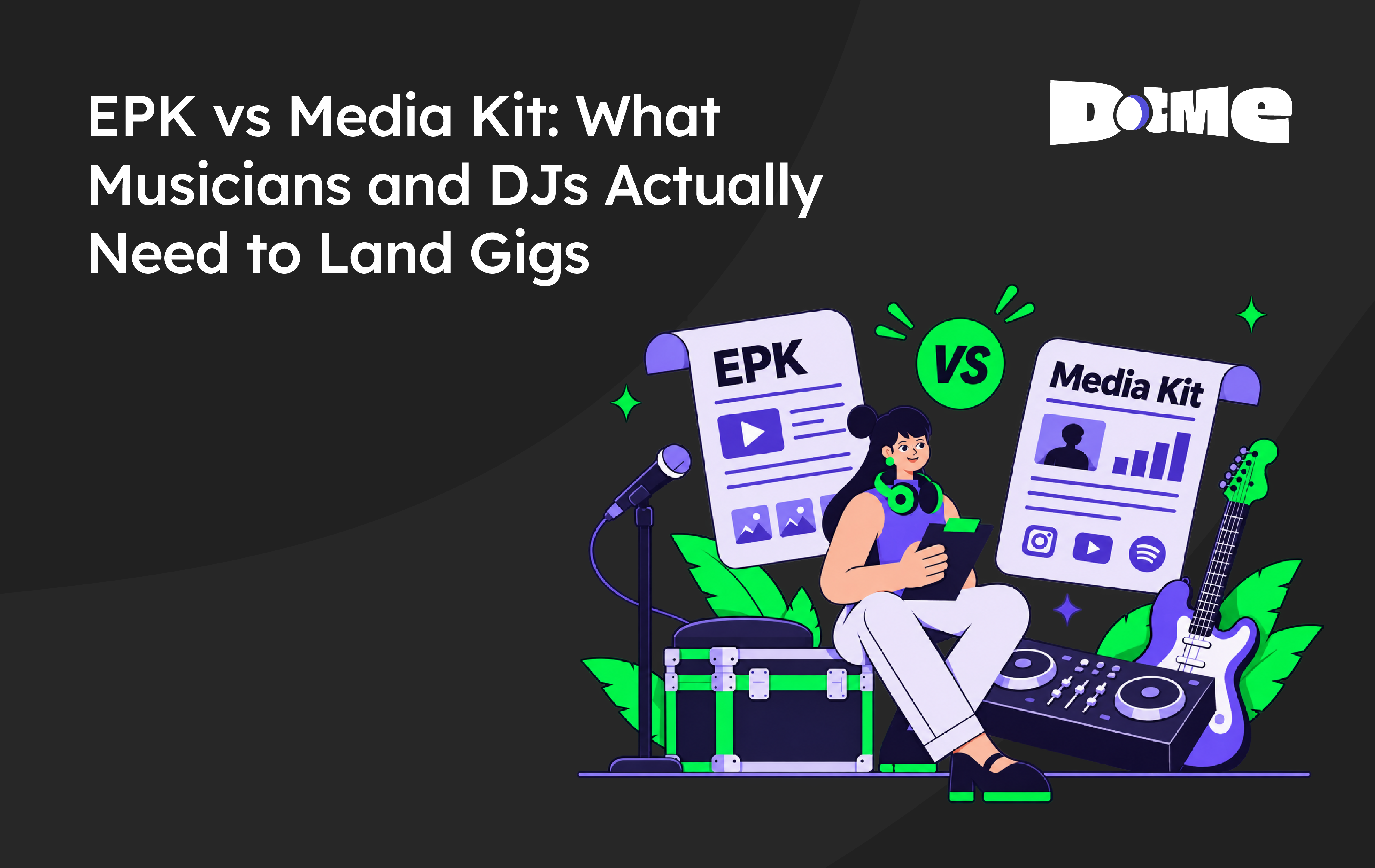
If you have ever tried to get booked for a gig, a festival slot, or a brand partnership as a musician or DJ and been asked to "send your EPK," you already know the mild panic that follows if you do not have one ready. And if you have been in the music industry long enough, you have probably also wondered at some point what the actual difference is between an electronic press kit and a media kit, whether you need both, and whether the one you have is actually doing the job it is supposed to do.
The confusion is understandable because the terms get used interchangeably in some circles and treated as completely distinct documents in others. The honest answer is that they serve related but genuinely different purposes, and understanding that difference is what determines whether you build the right tool for the specific opportunity you are trying to unlock.
This guide breaks down what an EPK is, what a media kit is, how they differ in purpose and content, and what musicians and DJs specifically need in 2026 to land gigs, festival slots, press coverage, and brand deals with professional credibility.
Key Takeaways
- An electronic press kit and a media kit are not the same document: An EPK is designed for press, booking agents, and promoters. A media kit is designed for brand partners and sponsors. Knowing which one you need for which opportunity stops you sending the wrong document at the wrong moment.
- EPK meaning in the music industry is specifically about credibility and booking potential: It answers the questions that promoters, festival programmers, and journalists ask before they commit to featuring or booking an artist.
- An artist media kit is increasingly necessary alongside an EPK as music brand partnerships have grown: The creator economy has expanded into music and the musicians and DJs generating significant income from brand deals need a separate commercial document to support those conversations.
- EPK examples that work share one characteristic: They make the booking decision easy, not just impressive. Clarity and credibility over aesthetic ambition.
- Your Dotme link in bio is the natural home for both documents: A well-built creator profile with embedded EPK and media kit capability means industry professionals can access everything they need from a single link without the friction of email requests.
- The best artist EPKs in 2026 are digital, interactive, and always current: A static PDF that was last updated eight months ago is not serving your career the way a live, link-accessible EPK does.
EPK Meaning: What It Actually Is
An electronic press kit, EPK for short, is a digital document that gives music industry professionals, specifically promoters, booking agents, festival programmers, venue managers, and journalists, everything they need to evaluate an artist for booking or coverage in one place.
The EPK meaning in music is rooted in the traditional press kit that artists would physically mail to radio stations and publications before digital distribution existed. A physical folder of bio, press photos, and a CD or cassette. The electronic version evolved from that model and in 2026 lives primarily online rather than in an attachment, which is both more practical and significantly more effective for discovery purposes.
What makes an EPK different from a general artist profile or a social media presence is its specific purpose and its specific audience. An EPK is not trying to connect with fans. It is trying to convince industry decision-makers to invest time, money, or platform in an artist. The people reading an EPK are asking a specific set of questions. Is this artist ready to perform at the level I need? Do they have a genuine audience and a track record? Are they professional enough to work with? And is there a compelling narrative around this artist that justifies the risk of featuring them?
A strong EPK answers all of these questions with evidence rather than assertion.
What an Artist EPK Should Include
Artist Bio Written for Industry, Not Fans
The bio in an EPK is doing different work from the bio on your Instagram or your streaming profile. A fan bio builds emotional connection and tells an origin story. An EPK bio establishes credibility and communicates positioning for an industry reader who wants to understand quickly who you are, where you sit in the landscape, and why you are worth paying attention to.
A strong EPK bio is specific about genre and sound without being so technical that it only makes sense to specialists. It references meaningful career milestones, releases, and press in a way that demonstrates trajectory rather than just history. And it communicates the artist's live performance credentials and touring experience, because for booking purposes the most important question is whether you can deliver for an audience.
Keep it to two or three concise paragraphs. An EPK bio that runs to five hundred words is a bio that is asking a busy promoter to do more work than they are willing to do for an artist they have not yet committed to.
Music: Embedded and Immediately Accessible
This sounds obvious but the number of EPKs that require a booking agent to navigate to a separate platform, create an account, or wait for a download to complete before hearing any music is genuinely high. Music must be embedded and immediately playable within the EPK itself, or linked in a way that opens in one tap and starts playing within seconds.
A Spotify embed, a SoundCloud player, or a direct streaming link to your two or three strongest tracks is the standard. Include your best work and your most representative work, which are not always the same thing. If you are pitching for a specific type of booking, the music you feature should be the music that demonstrates your fit for that context rather than necessarily your personal favourites.
EPK Examples: What Press and Performance Footage Does
Video is the element that separates EPKs that book gigs from ones that get polite rejections. A promoter who can watch two minutes of live performance footage and see how you command a room, how your set builds energy, and how an audience responds to you has enough information to make a provisional booking decision. An EPK without video leaves that decision hanging on less compelling evidence.
Live performance footage does not need to be professionally produced. Authentically captured live video often performs better in EPK contexts than highly produced music videos because it more accurately represents what the booking party is actually paying for. Footage from a real show at a comparable venue, with real crowd energy visible and audible, is your most persuasive single piece of EPK content.
If you have a music video or visual content that represents the artistic quality of your work, include it as a secondary element after the live footage rather than in its place.
Press and Recognition
Press coverage, playlist placements, radio play, festival credits, and any other third-party validation of your work belongs in the EPK as social proof that the music industry has already taken notice. You are not the only one saying you are worth booking. Here is the evidence that others have already decided the same thing.
For emerging artists with limited press history, festival credits and support slots for established acts carry similar credibility signals. Even smaller but meaningful placements, a feature in a respected regional publication, a playlist addition from a credible curator, communicate that your work has passed some kind of external quality filter, which is what the booking party needs to feel comfortable making a decision.
Technical and Logistics Information
A section of your EPK that is frequently undervalued but deeply appreciated by the promoters and venue managers who receive hundreds of artist submissions is the technical and logistics section. Stage plot, technical rider, set length options, and availability are the practical information that moves a booking conversation from consideration to confirmation.
Including this information in your EPK demonstrates professional experience and reduces the back-and-forth friction that characterises early booking conversations. It signals that you have done this before, that you understand what venues and promoters need to know, and that working with you is going to be straightforward rather than complicated.
Contact and Booking Information
Your EPK should make it completely frictionless to reach the right person for a booking conversation. Artist name, management or booking contact name if applicable, email address, and a phone number or WhatsApp for time-sensitive discussions. If you are self-managed and handling your own bookings, say so clearly because some promoters prefer dealing directly with artists while others prefer dealing with management, and either way they want to know who they are contacting.
Artist Media Kit: The Different Document You Also Need
Here is where many musicians and DJs are currently leaving money on the table. The EPK is built for the music industry. The artist media kit is built for brand partnerships, and those are increasingly two separate commercial conversations that require two separate documents.
Brand partnerships in music have grown significantly as the creator economy has expanded. DJs with strong social followings are securing deals with beverage brands, fashion labels, tech companies, and lifestyle products. Musicians with engaged online communities are working with streaming platforms, equipment brands, and cultural organisations. These are commercial relationships that require a different kind of professional document from the one you send to a festival booker.
A brand partner evaluating a musician or DJ for a commercial collaboration is not primarily asking whether you can deliver a great live performance. They are asking whether your audience is the right audience for their product, whether your content quality matches their brand standards, whether your engagement rate suggests your audience actually listens to your recommendations, and what the commercial terms of a partnership would look like.
An artist media kit answers these questions rather than the booking questions an EPK answers. It includes your social platform statistics with audience demographic breakdowns, your engagement rate data, your content performance evidence, examples of any past brand collaborations with performance metrics, and a rate card for different types of commercial partnership from sponsored posts to brand ambassador arrangements to event appearances.
The media kit for a musician or DJ is structurally similar to the media kit any creator would build, but the content reflects the specific cultural authority and audience relationship that comes from a music career rather than a general content creation background.
EPK vs Media Kit: When to Send Which
The practical rule is straightforward once the distinction is clear. Send your EPK when someone is evaluating you for a music industry opportunity: a booking, a festival application, a label conversation, a press feature, a radio submission. Send your media kit when someone is evaluating you for a commercial partnership: a brand deal, a sponsorship, a paid appearance for a non-music brand, a content collaboration.
In some cases you need both. A festival that is also looking for artists to partner with sponsors needs to see both your booking credentials and your commercial audience data. A brand that is hosting a music event and wants to book you as the headline act needs to evaluate both your performance credentials and your audience fit with their customer profile.
Having both documents ready, professionally built, and accessible through a single link in your Dotme profile means you are never the artist who has to say "can I send that to you later?" when an industry professional or brand manager asks for your materials in a conversation that could be moving toward an opportunity.
Why Your Dotme Profile Is Where Both Should Live
The most practically significant upgrade most musicians and DJs can make to their EPK and media kit setup in 2026 is moving from static PDFs to a live, always-current digital presence that houses both documents in a single accessible location.
Dotme's creator profile lets you build a hub that includes your embedded music, your live performance video, your press and booking information, your social statistics and audience demographics, your past brand work, and your contact details, all in one place and all accessible to anyone who finds your profile through any channel. A festival programmer who discovers your music can access your full EPK within seconds. A brand manager who finds your Instagram can reach your media kit with a single tap.
Because Dotme updates in real time, your follower counts, your streaming numbers, and your engagement data always reflect your current position rather than where you were when you last rebuilt a PDF. A booking agent evaluating you six months from now is seeing your current numbers, not your outdated ones. That currency matters for both credibility and accurate commercial valuation.
Final Word: Build Both, Know When to Use Each
The artists and DJs building the most complete professional infrastructure in 2026 are the ones who have stopped treating their EPK as the only document that matters for their career and started recognising that the music industry and the brand partnership world require different professional tools for different conversations.
Build your EPK with your music, your live footage, your bio, your press, and your technical information. Build your media kit with your audience data, your social statistics, your content performance, and your commercial rates. Keep both current. Host both somewhere accessible. And when the opportunity arrives, send the right one.