

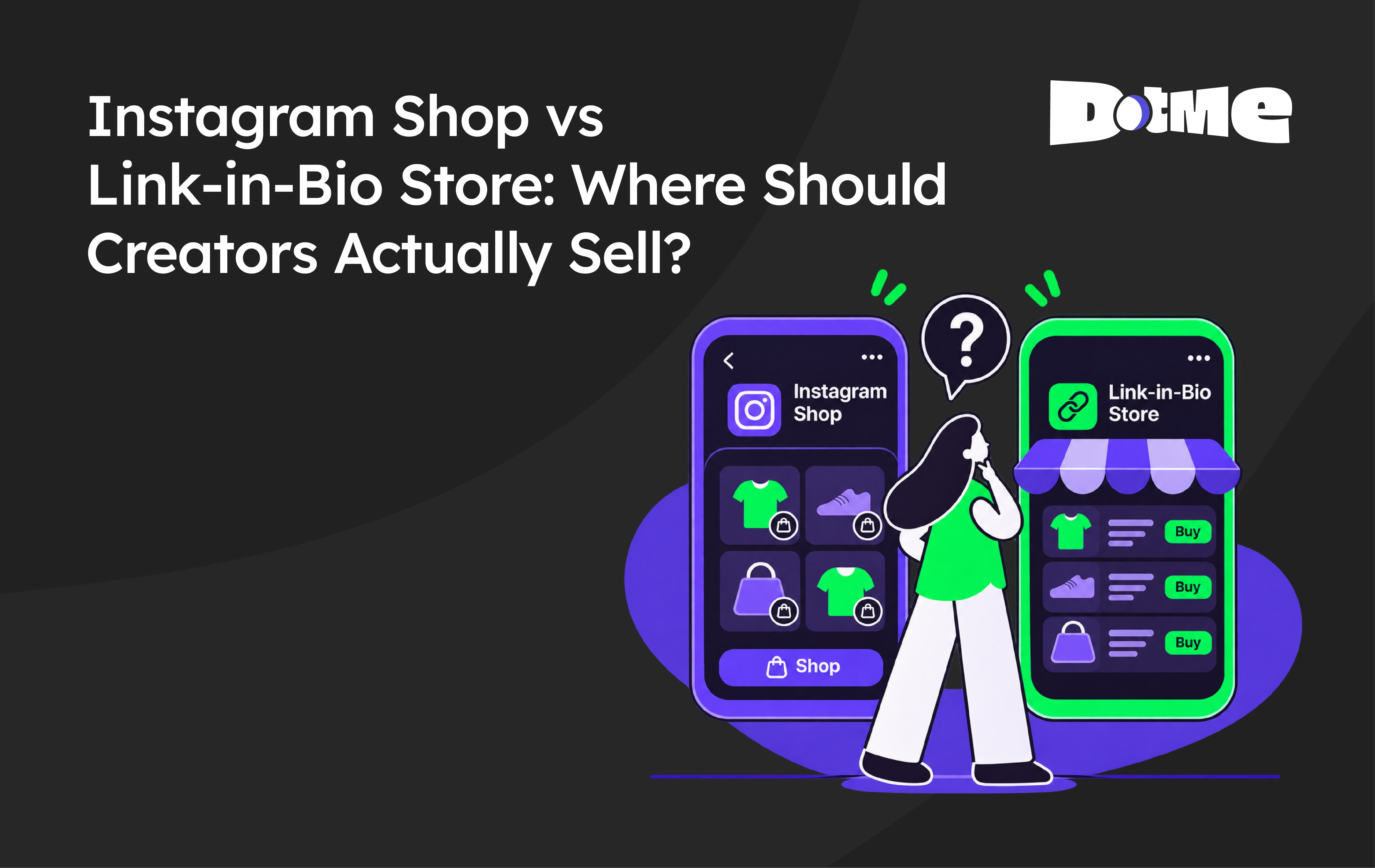
Instagram wants you to sell inside Instagram. That is not a conspiracy theory or a cynical read of the platform's intentions. It is just the commercial reality of a platform that has invested significantly in native commerce features because keeping transactions on-platform is good for Instagram's business model. Instagram Shop, product tags, the Shop tab, checkout within the app: all of it is designed to make the purchase journey feel complete without the user ever leaving Instagram.
And for some creators, selling entirely through Instagram makes perfect sense. But for a growing number of creators in 2026, the Instagram Shop setup is creating a dependency on a single platform's infrastructure, algorithms, and policies that carries real commercial risk. A link-in-bio store, specifically one built through a platform like Dotme, offers a fundamentally different commercial model. One where you own the storefront, control the experience, and are not subject to the platform's changing terms every time Instagram decides to modify how commerce works.
This guide breaks down the honest comparison between Instagram Shop and a link-in-bio store, what each one does well, where each one creates problems, and how to decide which approach, or which combination of both, is actually right for your creator commerce strategy.
Key Takeaways
- Instagram Shop is powerful for discovery but creates platform dependency that carries commercial risk: When your entire store lives inside Instagram, every algorithm change, policy update, and feature modification directly affects your revenue.
- A link-in-bio store gives you commercial infrastructure that travels across every platform you create on: Your Dotme store is accessible from Instagram, TikTok, YouTube, and anywhere else you share your link, not just from within one platform's ecosystem.
- Instagram Shop setup is optimised for Instagram's commerce experience, not yours: The checkout, the product presentation, and the post-purchase experience are all governed by Instagram's design decisions rather than your brand decisions.
- Dotme's built-in store feature lets you sell directly from your link in bio with your own branding and your own commercial terms: Physical products, digital downloads, affiliate links, and direct offerings can all live in one place under your brand identity.
- The most commercially resilient creator commerce strategies use both: Instagram Shop for discovery and native platform reach, link-in-bio store for owned commerce infrastructure that is not dependent on any single platform's goodwill.
- Real-time analytics across your link-in-bio store give you commercial data that Instagram's native analytics cannot provide: Knowing exactly which products are converting from which content pieces is the data that makes creator commerce a strategy rather than a guess.
What Instagram Shop Actually Is and How It Works
Instagram Shop is Meta's native commerce feature that allows creators and businesses to create a digital storefront directly within Instagram, tag products in posts and reels, and enable followers to browse and purchase without leaving the app. The Instagram shopping experience is integrated into the platform's discovery architecture, which means products can surface in the Shop tab, in Explore, and in shoppable posts and reels that appear across the feed.
For creators with physical products or brand partnerships that involve product sales, the Instagram Shop setup process involves connecting a product catalogue either directly through Instagram's commerce tools or through an integrated ecommerce platform like Shopify. Once set up, product tags can be added to content, creating a seamless browsing experience where a viewer can tap a product in a post, see the price and details, and complete a purchase without the friction of navigating to an external website.
The native checkout feature, available to eligible accounts in supported markets, takes this further by completing the entire transaction inside Instagram, meaning the customer never leaves the app at any point in the purchase journey.
From a pure conversion friction perspective, this is compelling. Fewer taps between discovery and purchase means fewer opportunities for purchase intent to dissipate. The commerce experience is familiar to Instagram users because it operates within an interface they use daily. And the platform's discovery features mean that shoppable content has the potential to reach audiences beyond your existing followers through algorithmic distribution.
The Problems With Relying Entirely on Instagram Shop
Instagram Shop is a genuinely useful commerce tool and it is not a complete commerce strategy for any creator who is serious about building a sustainable business. The reasons for this are structural rather than minor inconveniences.
Platform dependency is the most significant. When your store lives inside Instagram, your revenue is directly tied to Instagram's algorithm, Instagram's policies, and Instagram's decisions about how commerce features work. Instagram has modified, restricted, and in some markets removed commerce features multiple times. Creators who built their entire sales infrastructure around Instagram Shop features that subsequently changed or disappeared learned an expensive lesson about the risk of building a business on rented land.
The discovery and discoverability advantage of Instagram Shop is real but it is also controlled entirely by Instagram. Your products appear where Instagram's algorithm decides they appear. Your shop tab looks the way Instagram's design team decided it should look. Your checkout experience is governed by Meta's technical and policy decisions. None of these are within your control, which means none of them are stable commercial variables you can plan around with confidence.
The data limitation is a second significant problem. Instagram provides analytics on product views and some purchase data, but the granularity and portability of that data is limited by what Instagram chooses to share with creators. Understanding precisely which pieces of content are driving sales, building a customer relationship database, and developing the kind of detailed commercial intelligence that allows you to optimise your strategy over time is significantly harder when your entire commerce operation sits inside a platform that controls your access to your own business data.
Finally, Instagram Shop requires an Instagram account in good standing and compliance with Instagram's commerce policies, which means any account issue, policy violation, or platform ban immediately affects your revenue. A creator who has built their entire commercial infrastructure inside Instagram has a single point of failure that is not within their control to prevent.
What a Link-in-Bio Store Offers That Instagram Shop Cannot
A link-in-bio store built through Dotme operates on a fundamentally different commercial model. The store lives on your Dotme page, which is accessible from your Instagram bio, your TikTok bio, your YouTube description, your Twitter profile, and anywhere else you share your link. It is not dependent on any single platform's features, policies, or algorithmic decisions.
Dotme's built-in store feature lets you showcase products in a clean, visually appealing format directly within your link-in-bio page. Physical products, digital downloads, courses, templates, and affiliate links can all be presented in a single storefront that reflects your brand identity rather than Instagram's design system. When a visitor arrives on your Dotme page from any platform, they encounter a commercial experience that is coherent with your brand, not with Instagram's.
The commercial terms of your Dotme store are your commercial terms. You set prices, you define what you are selling, and you connect to the checkout or fulfillment infrastructure that makes the most sense for your specific business rather than the one that Instagram has decided to integrate with. For creators selling digital products, Dotme allows you to build a direct sales channel that keeps a significantly higher proportion of revenue than marketplace arrangements or platform-mediated transactions.
The audience relationship built through a link-in-bio store is also qualitatively different. A customer who follows a link from your content to your Dotme store and makes a purchase there is building a relationship with your brand rather than with Instagram's commerce infrastructure. That relationship is yours to develop, to build on, and to serve independently of any platform.
The Analytics Advantage of a Link-in-Bio Store
One of the most commercially significant differences between Instagram Shop and a Dotme link-in-bio store is the analytics available to you as the store operator, and understanding this difference is what moves creator commerce from activity to strategy.
Dotme's built-in analytics show you which links on your page are generating clicks, where your page traffic is coming from, and which products are attracting the most interest. When this data is tracked alongside your content performance data, it creates a direct line of sight between specific pieces of content and specific commercial outcomes. You can see whether the reel you posted on Tuesday drove more product interest than the carousel you posted on Thursday. You can see whether your Instagram audience or your TikTok audience is more commercially engaged with your product offerings. You can see which product in your store is consistently the most clicked and use that insight to inform both your content calendar and your product development priorities.
This level of commercial intelligence is not available to the same degree through Instagram's native analytics, which are designed to tell you how content performs within Instagram's ecosystem rather than how your commercial proposition performs across the full scope of your creator business. The creator who tracks their Dotme analytics regularly is making product and content decisions based on evidence. The creator relying entirely on Instagram Shop analytics is working with a partial picture.
Setting Up Instagram Shop: What the Process Actually Involves
For creators who decide that Instagram Shop is right for their strategy, either as a primary channel or as a discovery complement to a link-in-bio store, understanding the Instagram shop set up process is useful preparation.
The setup requires a professional or creator account on Instagram, compliance with Instagram's commerce eligibility requirements, and connection to a Facebook Page. You then either create a product catalogue directly through Facebook's Commerce Manager or connect an existing ecommerce platform like Shopify, WooCommerce, or BigCommerce that has a native Instagram integration.
Once the catalogue is connected and the shop is approved by Instagram, products can be tagged in posts, reels, and stories. The Shop tab appears on your profile allowing visitors to browse your full catalogue. And in markets where Instagram checkout is available, the purchase can be completed entirely within the app.
The process is moderately complex, particularly the catalogue setup and the Facebook Business Manager infrastructure that sits behind it. For creators selling a small number of products, the operational overhead of maintaining an Instagram Shop is often higher relative to the return than a straightforward Dotme store that can be set up and updated more easily and with less platform-specific infrastructure.
The Integrated Approach: Using Both Strategically
The most commercially sophisticated answer for most creators in 2026 is not to choose between Instagram Shop and a link-in-bio store but to use both with a clear understanding of what each one is doing in the commercial strategy.
Instagram Shop serves discovery. Shoppable posts and product tags allow products to surface through Instagram's distribution channels, reaching audiences who might not have navigated to your bio link but who encounter a product tag in a piece of content and are moved to investigate. This discovery function is genuinely valuable and there is no reason not to use Instagram's commerce features for the reach they provide.
A Dotme link-in-bio store serves owned commerce. It is the destination where your most commercially engaged audience, the people who tap your bio link, encounters a complete, branded, multi-product commercial experience that is not dependent on Instagram's infrastructure. It is the foundation of a creator commerce model that will survive any platform change, policy update, or algorithm shift because it does not live inside any single platform.
The practical integration is straightforward. Product tags in Instagram content drive discovery and surface products to a wide audience. The bio link directs the most engaged audience to the Dotme store for a complete commercial experience. And the analytics from both sources together give you a complete picture of how your commercial content strategy is performing across the full purchase journey.
Final Word: Own Your Storefront
The commercial lesson that creators who have been building businesses online for any length of time have learned, often through expensive experience, is that building on a single platform's infrastructure is building on sand. Instagram Shop is a powerful discovery tool that you should absolutely use. It is not a complete commerce strategy and it should not be the only place your products live.
A Dotme link-in-bio store is owned by infrastructure. It travels with you across every platform. It reflects your brand rather than Instagram's design. It gives you commercial data that belongs to you. And it remains fully functional regardless of whatever Instagram decides to do with its commerce features next year.
Use both. Let Instagram drive discovery. Let your Dotme store be the commercial foundation that does not depend on anyone's algorithm to keep working.